Murals and large prints in Minneapolis

Forest scenes, botanical murals, maps, chinoiserie panels and custom prints. A mural is one picture cut into drops, so the work is in placing it on your wall and keeping every panel matched to the next.

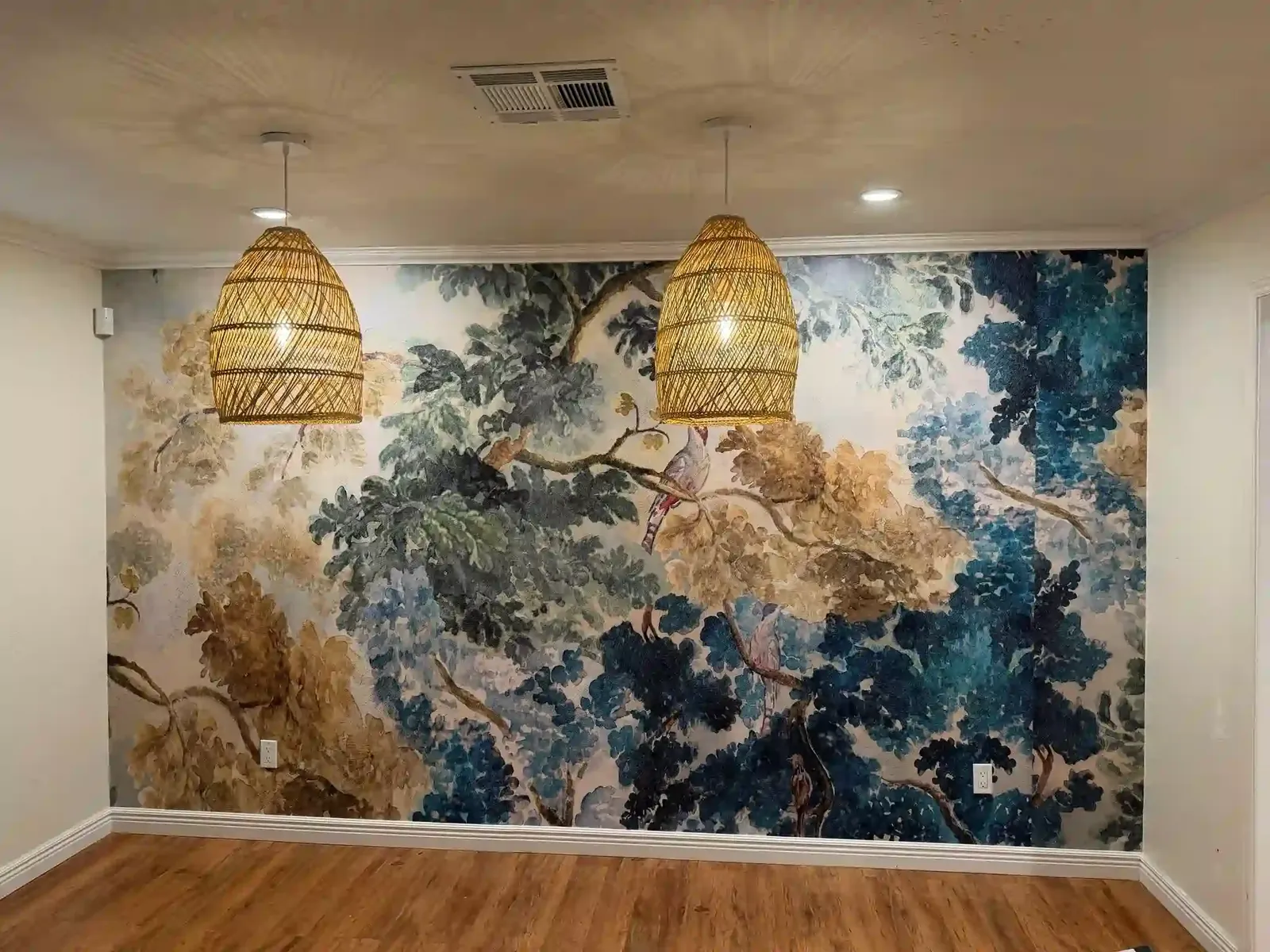
Blue and gold tree-canopy mural across a dining wall under two woven pendant lights

A picture, not a pattern

Ordinary wallpaper repeats, so any strip can follow any other. A mural does not: each panel is a different part of one image and has exactly one place on the wall. That changes everything about the job. Panels arrive numbered, usually left to right, and the order matters more than speed.

Murals are made to a size. Some are sold as fixed sets of panels; many are printed to your wall measurements with a little extra image, called bleed, around the edges for trimming. Before the job we compare the mural's size to the wall and decide where the extra goes.

Placing the focal point

The most common disappointment with a mural is a focal point in the wrong place: a tree trunk hidden behind a headboard, a sun cut by a light switch, a face split by a door frame. We lay the panels out on the floor or hold them up dry, mark where furniture, outlets and doors fall, and agree with you where the image sits before any paste comes out.

On walls that are not square, which describes many older Twin Cities houses, the mural is hung plumb from a drawn line and the extra image at top and bottom absorbs the difference. A mural hung to a sloping ceiling would carry that slope across the whole picture.

The wall under the picture

Large images show the wall behind them as clearly as plain paper does, and a mural usually covers a whole wall, often the one you see first. Cracks, patches and texture are repaired and skimmed, then the wall is primed with a wallcovering primer. On dark murals a primer tinted toward the image color helps hide any hairline at a seam.

We also check the material. Murals are printed on non-woven, paper, vinyl or fabric bases, and some are peel-and-stick. Each has its own adhesive and handling, and the maker's instructions decide whether panels butt or overlap.
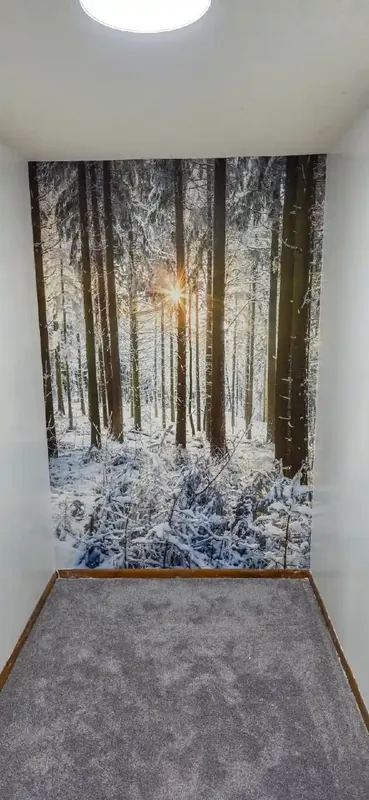
Snowy forest photo mural with low sun between the trunks, filling the end wall of a small room

Hanging panel by panel

The first panel goes up against a plumb line, not a corner. Each following panel is matched to the one before at eye level first, then smoothed up and down, so the image lines up where people look. Butted panels are pressed tight; overlapped panels are double-cut where the instructions call for it.

Trimming at the ceiling, base and side walls is done after the paste has grabbed but before it sets hard, with a fresh blade each time. We step back often. A mural that is a few millimeters off at one seam is invisible; one that drifts across six panels is not.

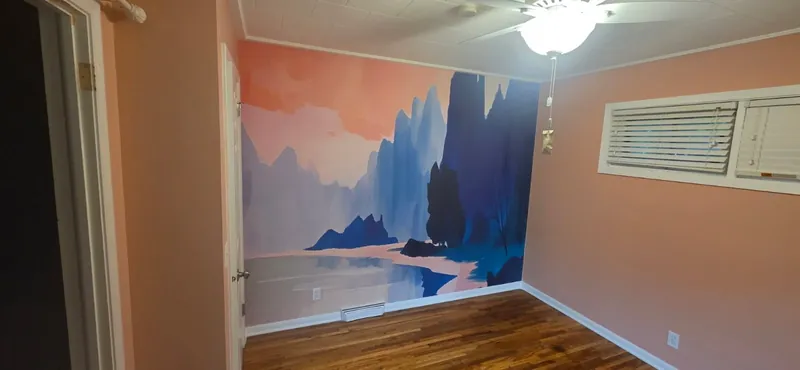
Blue mountain-and-lake mural on one wall of a peach bedroom

Murals on stairwells, ceilings and odd walls

Stair walls are tall and the bottom edge follows the stair, so panels have to be cut on a rake while keeping the image matched. We set up safe staging, plan which panels land over the stairs, and hang from the top down. Ceilings, sloped attic walls and walls broken by built-ins are possible too; they need more planning time and sometimes a slightly larger print.

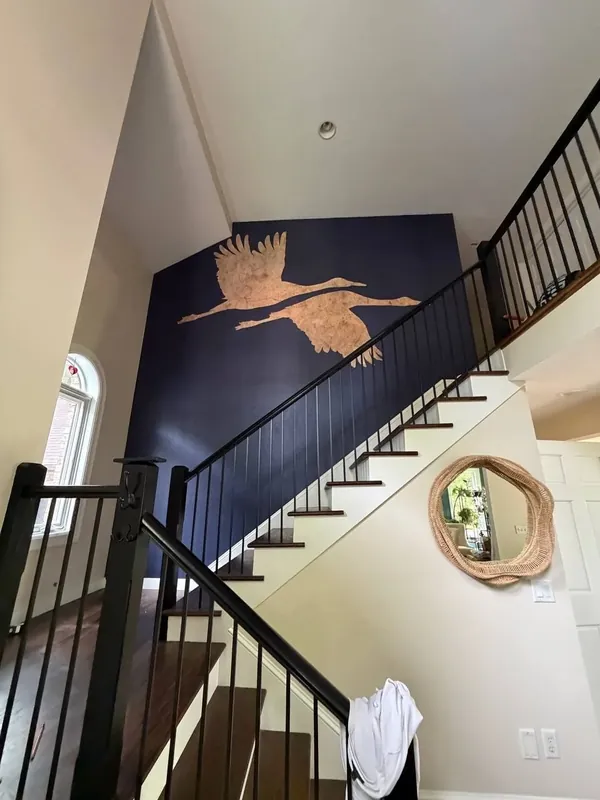
Copper flying-crane mural on a navy feature wall rising beside a black stair railing

Choosing the base: non-woven, paper, vinyl or peel-and-stick

Non-woven murals are the easiest to live with: they go up on a pasted wall, hold their size while they dry and usually strip off dry later. Paper murals can look a little softer and richer, but they stretch when pasted and need careful booking so the panels still match. Vinyl murals are washable and tough, which suits kitchens, kids' rooms and businesses.

Peel-and-stick murals avoid paste, but they grip hardest on smooth, fully cured, primed walls and are not easy to reposition once they touch the wall. On textured or freshly painted walls they can lift at the seams. If you are deciding between bases for the same image, ask us before you order; the wall often decides for you.

Kids' rooms and murals that will change

A jungle or a map for a five-year-old may not suit them at twelve. If a mural is likely to come down in a few years, choose a non-woven or other strippable base and let us prime the wall with a wallcovering primer, so removal later is a dry peel rather than a wet afternoon of scraping.

Kids' rooms also take wear. A washable vinyl or coated non-woven handles marker and hands better, and corners where beds and toys bump the wall can be planned so a seam does not sit right on them.

Ordering a mural

If the mural is printed to size, send the maker your wall width and height as measured, and ask how much bleed they add. We are glad to measure for you before you order; one wrong number on a custom print is expensive. Keep the panels flat and dry until the job, and do not open them in a humid room.

Ready-made mural sets are sized in fixed widths. If the set is wider than your wall, we decide together which side of the image to lose; if it is narrower, it may need a border of plain wall or a second wall to balance it.

Questions about murals and large prints

Can you measure for a custom mural?

Yes. We measure the wall and give you width, height and the trim allowance to send to the print shop.

What if my wall is wider than the mural?

We look at the image together and decide whether to center it, leave a border, or order a wider print.

Can a mural go on a ceiling or a stairwell?

Yes, with planning. Stairwells need staging and raked cuts; ceilings need extra hands and a very smooth surface.

Is peel-and-stick a good choice for a mural?

It can be, on a smooth, fully cured wall. It is less forgiving of texture and harder to reposition than many people expect.

How long does a mural take to hang?

Most single-wall murals are hung in a day once the wall is ready. Repairs, skim coating and primer come first and need drying time, so a wall that needs work may take two or three visits. Large commercial murals, stairwells and ceilings take longer, and we give you a schedule with the estimate.

Will the panels line up perfectly?

On a good print and a sound wall, yes, to the eye. Prints can vary slightly in size, which is why we match at eye level and let small differences fall at the ceiling and floor.

Price your murals job

Which room, about how big, and which paper. We call back to set a time to see the wall.

(763) 363-5382 [email protected]
Elliot Wallpaper Hanger
701 S 25th Ave, Minneapolis, MN 55454
Which room?
Room, wall size, wallpaper type

(763) 363-5382 Free estimate